The Chinese term Quanfa (pronounced Chuan Fa) or Kempo in Japanese is a hybrid martial art that translates to “Fist Law” or “Fist Method”, originating from Chinese Chuan Fa (Wushu/Kung Fu) and evolving through Okinawan & Japanese traditions.
Our approach values thoughtful practice over empty display. Training can draw from both cultures while respecting the context, methods and identity of each tradition.

The Mandarin reading of the same characters, meaning “fist method”. Quanfa can describe Chinese boxing methods broadly, within the wider landscape of Kung Fu and Wushu traditions.
A Japanese reading of the characters 拳法, associated with “fist method”. Kempo is often a term used to describe Japanese martial arts of Chinese origin. Kempo traditions vary, and may include striking, close-range methods, throws, locks, ground wrestling and broader self-protection skills.
The characters 拳法 are read as Quánfǎ in Mandarin Chinese and Kempō or Kenpō in Japanese. They are often translated as “fist method”.
The shared characters offer a useful point of connection, but they do not mean that every Chinese or Japanese school belongs to the same lineage. The details live in each art’s history, training methods and teachers.
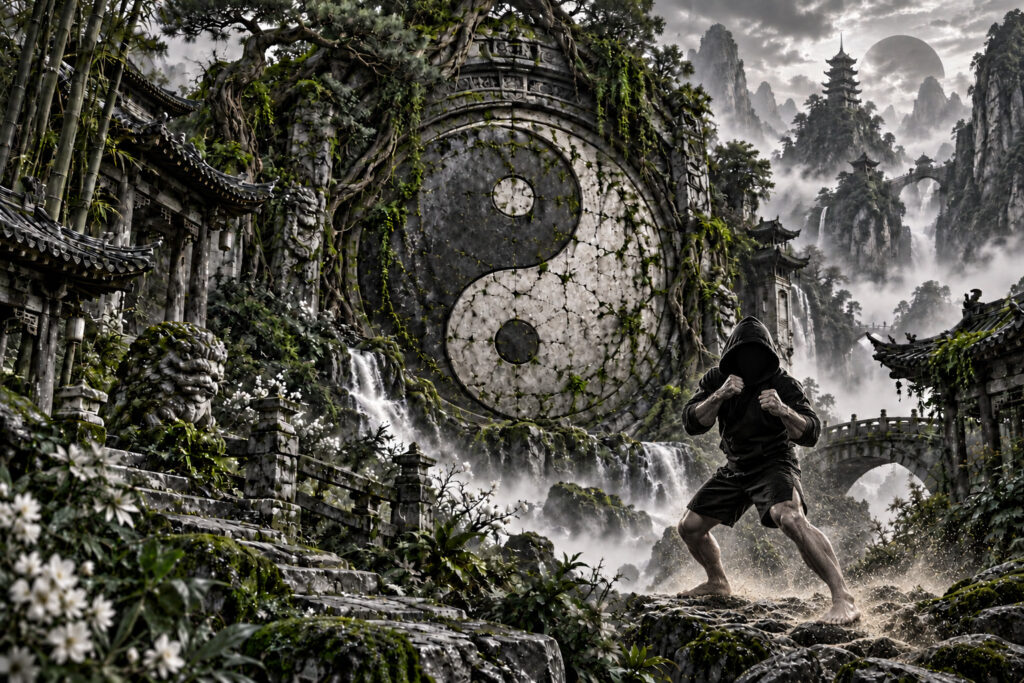
The yin-yang symbol is significant in martial arts because it represents the balance of opposing forces: softness and strength, defence and attack, stillness and movement. Rather than relying on power alone, a martial artist learns to adapt—yielding when appropriate, acting decisively when needed, and finding control in the shifting relationship between the two. The symbol also reminds practitioners that each force can contain the potential for its opposite: a defensive movement can create an opening to counter, while excessive aggression can leave someone vulnerable. This idea shapes both technique and mindset, encouraging balance, discipline, and awareness in practice.
Build timing, distance, balance, coordination and controlled power through deliberate practice.
Explore footwork, posture, evasion, structure and the transitions between ranges.
Study clinch work, off-balancing, throws, control and escapes where appropriate to the curriculum.
Train with patience, consistency, humility and respect for training partners.
Keep what proves useful, understand why it works, and continue to refine your practice.
Bring effort and calm together: committed practice without losing awareness or control.
Qigong (氣功) is a traditional Chinese practice combining gentle movement, breathing, posture and focused awareness to cultivate Qi (氣), or vital energy. Rooted in Chinese philosophy and medicine, it aims to support physical health, mental clarity and emotional balance.
Often called moving meditation, Qigong may improve balance, flexibility and relaxation while helping manage stress. Its practices harmonise body, breath and mind through mindful movement and stillness.